Tuesday, July 8, 2025

A Bright New Future for Gamelyn Games

Gamelyn Games, the publisher behind the Tiny Epic series, has been sold to Tycoon Games.

Michael Coe, co-founder of Gamelyn, posted yesterday on social media announcing the purchase.

"I'm sharing a monumental milestone: Gamelyn Games, Tiny Epic, and Heroes of Land, Air & Sea are now part of the incredible team at Tycoon Games".

Gamelyn Games was founded in 2011 by Brittany and Michael Coe with the aim of publishing Michael's first game, Lords, Ladies & Lizards. Their first success, however, came from the self-published and crowd funded, Dungeon Heroes in 2013. Also that year, Gamelyn successfully crowdfunded Fantasy Frontier.

The start of the Tiny Epic series came about the next year in 2014 with the publishing of Tiny Epic Kingdoms, designed by Scott Almes. This became their highest funded project to date and was quickly followed by Tiny Epic Defenders.

Since Tiny Epic Kingdoms, the Tiny Epic series has expanded to include exploring galaxies, surviving zombie outbreaks, raising baby dinosaurs, sailing as swashbuckling pirates, and so much more.

In 2020 Tiny Epic Pirates became Gamelyn's highest funded game at over $1.1 million, which was quickly followed by their first straight to retail game, a streamlined version of Tiny Epic Galaxies; Tiny Epic Galaxies BLAST OFF!

Coe wrote on the announcement of Gamelyn's sale that the Tiny Epic series has "become something far beyond what I ever imagined."

Gamelyn Games' mission was to create profound and unprecedented gaming experiences, and their vision was to develop Tiny Epic into the most well-known and respected series in all of board gaming. While that is certainly an ambitious vision, there is no doubt that the Tiny Epic series has had unparalleled success in condensing game genres famed for their complexity and size into surprisingly small and uniform boxes.

Tycoon Games, publisher of Everdell, was founded by Dan Yarrington with the core values to "Be Excellent", "Innovate Always", and "Care Deeply". They also donate extensively to good causes such as Toys for Tots, with over 450,000 games donated to kids and families.

We will wait to see in what new directions Tycoon Games plans to take the Gamelyn collection.

"Dan Yarrington... has been a trusted partner of Gamelyn's for over a decade, helping us fulfill campaigns and representing our games in distribution in the early years. He understands Tiny Epic deeply, and I know the series is in wonderful hands."

Coe confirmed in his statement that Scott Almes will be staying on as designer of the Tiny Epic series.

"The best is yet to come."


Thursday, July 3, 2025

Dungeons & Dragons and Drinking

On 1st August this year I will be one year sober, and while a lot of my own hard work has gone into this achievement, I also recognise the role table top gaming has played in helping me make the change.

I was once a prolific drinker and even more so at social gatherings. Having a drink while playing TTRPGs seemed like the most natural thing to me. Alcohol is a social lubricant, and in a situation where you were required to lower inhibitions and get into character, or many characters if you are the GM, drinking felt like the obvious choice. For a long time I felt like having a drink, or several, while playing, kept me loose and relaxed. It made me feel like I was better at getting into the flow of the game and unleashed my creative side on the fly when responding to the actions of the player characters.

I used to pair my drinks with the games I was playing, not just TTRPGs but board games too. A glass of wine for Horrified, a strong grog with Pirate Borg, and a pint of foaming ale with Dungeons & Dragons. Each game seemed to offer an opportunity to have a drink. Table top gaming was a relaxing pastime so why not share it with a relaxing drink?

I have always had a difficult relationship with drinking and have struggled to keep things in moderation. I always used to say that drinking was thirsty work. One drink would lead to the next and while I was happy and enjoying myself, through gaming I slowly started to realise that my drinking was more of a problem than I realised.
I have discussed before the importance of GMs to take time to decompress after TTRPG sessions, even if they are fairly relaxed. On top of this, there is always something to be gained from seeking some reassurance from your players that they had enjoyed what you had planned. However, when I was drinking, regardless of how much fun was had during the session, I had trouble decompressing and trusting the feedback I was being given from my players. My decompression time would become a spiral of negative emotions as I doubted any evidence before me that I had been entertaining enough. I focused on any and all negative points that my brain could give me. The session was too boring, or I was too intense (usually as a result of my drinking). I found the time I needed to decompress and adjust back to normal life increased the more I had been drinking. Sometimes days would pass and I would still not feel like I had entirely processed the experience.

This emotional hangover was difficult to deal with, often on top of your more traditional hangover. Of course, with hindsight I realise that the solution was simple, but at the time I internalised a lot of the emotions I was struggling with. The extended periods of recovery I needed after each session had me believing that I was not a good GM, that my players were just humouring me, that I should hand over the reigns to someone else. Despite all this I still was unable to come to the conclusion that drinking and DMing was affecting the whole experience for me in massively negative ways.

In the end, however, it was GMing that helped me recognise that my problem was not with the game, or my abilities, but with my drinking. I was getting too generous with magical items for my players and not remembering who I had given what. I was handing out game-breaking spells and magical artifacts that were completely throwing planned encounters. While I don't mind that my players probably enjoyed these boons, it made things very difficult in an almost entirely home-brewed world when I could barely remember what had happened each session. It really made me feel like I could be offering my players a much better experience if I avoided drinking while playing.
There are few better examples than that which transpired recently during a game of Pirate Borg we experienced a character death at the hands of a Sentient Fungus. The killing blow was made and the table fell silent as it became clear that there was no coming back from this for Luca the Zealot, the team's Glass Cannon. It was a truly sobering moment, which was only stopped when Luca played his Charon's Obol allowing him to return to life with 1HP. What troubled me was that I had absolutely no memory of awarding him this relic. The player informed me that I had handed it out many sessions ago when I had been drinking.

Don't get me wrong, it was still a fantastic moment of collaborative story-telling, but it really highlighted to me how much of a problem it was for me to not be remembering our sessions, or even to take notes. This all took place after I had quit drinking but stayed with me as a reminder that I was a better GM now that I had stopped. Drinking was making me sloppy.

Tabletop games didn't just help me realise that I had a problem with drinking, they helped me readjust my life to accommodate my sobriety. Gaming sessions began to revolve around coffee and cake rather than drinking, and our regular meet ups at Fruitworks Coffee Shop became a staple of my week. I found my life shifting away from the pub and towards bright, open cafes instead. Where I used to use alcohol as a social lubricant, table top games began to provide me with the relaxed atmosphere and aid to meet new people. 
During the week when I wasn't able to play with a group, I invested more time into solo board games as a means of unwinding and relaxing, rather than pouring myself a drink. The almost meditative nature of solo gaming was a cornerstone of my mental wellbeing. Through playing games I was able to enter a flow-state where I was completely unconcerned by the outside world and my inner demons. They gave me a rest from thoughts of drinking, as the structure and puzzle-like element of these games kept my mind satisfyingly occupied. 

It has been a journey for me but looking back I can really appreciate the role that table top gaming has played in helping me reach sobriety and providing me with a safe space to continue. This is a personal story for me and I am not using it as a way of saying others should do the same. Drinking is not inherently evil, and most people will never experience the same problems as I did. I just wanted to share my experiences so that if anyone happens to find themselves in a similar position to me, they might gain some encouragement to make the necessary changes. 

Monday, June 23, 2025

Hand Limit: Gaming In Real Life

Hand Limit is going through a lot of growth in recent weeks. We held our first in-person event, launched a Patreon, and announced our first steps into physical print with our new Hand Limit zine

We are also gearing up for some more input from the wider Hand Limit Collective. This will take the form of gaming-inspired artwork, articles covering cosy video-games, and reviews of TTRPG Actual Play podcasts. 

With all this exciting new material we put our heads together to come up with a suitable tagline for Hand Limit. We wanted something that clearly stated our intentions and incorporated our core values, but didn't take up a whole paragraph. That wouldn't make for a snappy tagline. If you want to read more about our core values, I recommend taking a moment to check out our About Us page.

Hand Limit stands for a lot of things; we believe in equality, equity, and inclusion, we believe trans rights are human rights, and black lives matter, and we believe in the rights of people with disabilities. We believe in making an inclusive space. We believe that engaging in the act of unproductive play as an adult in a capitalist society is an inherently rebellious act and is therefore political. Most prominently of all we believe in the power of tabletop games to improve mental health and promote community bonds, and a big part of this is the tangible nature of the hobby.

Considering this, we have decided that the tagline for Hand Limit should be "Gaming In Real Life". 

The University of Bath reports that "Loneliness is one of the most significant challenges faced by Western Societies in the 21st century... In the UK, surveys suggest that one in ten people are 'lonely', with loneliness being linked to ill health and premature mortality."

We are living in an increasingly digital age with more of our time than ever before spent consuming social media. However, the AMA Journal of Ethics states that "documented internet use patterns suggest that the internet increases loneliness." It cites an early study of the internet and psychological well-being found that greater use was linked to a decline in communication with family members, a decreasing social circle, and an increase in depression and loneliness. Loneliness, it states, "can be defined as the feeling we get when our need for rewarding social contact and relationships is not met."

While digital technology can "offer connectedness, companionship, and community membership", it cannot be ignored that problematic use of the internet, or internet addiction, is on the rise at the same time as loneliness. 

Tabletop games can offer a remedy to this by offering an opportunity for in-person interaction that has clearly defined parameters. Strangers occupying the same space and engaging in a shared activity, especially one that promotes playfulness, creates a space in which rewarding social contact can be achieved. Writing for meeplelikeus.co.uk, Michael Heron highlights that table top games provide "a healthy way for people to spend mindful time with each other.

Heron goes on to say that "everything about a board game has a focus on the people around the table... games do it through a conduit that lessens social anxiety." Tabletop games provide a focal point, a common ground, to encourage the players around the table to interact with each other in ways that other social activities such as drinking in the pub or going to the cinema do not. 

Then there's the simple fact that play in both children and adults is a healing activity that allows growth of character. We explore the world around us through the act of play, which provides us with a testing ground for our own actions. It lifts the weight of responsibility, even for a short while, and allows us all to engage in the fantastic, rather than the mundane. This act builds social bonds between us in ways that others take much longer to do. I have already written about how playing board games with strangers offers you a much faster insight into the inner-workings of other people around the table than traditional small-talk enables. How someone acts around the table in both cooperative or competitive situations, provides us with a much better grasp of how someone is likely to behave outside of play. This takes away a great deal of anxiety that people may feel in situations where they are getting to know new people.

Aside from the real-life social element of tabletop games, there is the physicality of the actual games. While online gaming can still offer a sense of community and connectivity, the very real, tangible nature of board games provides a sensory experience that even the most advanced virtual reality cannot replicate. The tactile nature of most board games provides a connection to the real world that boosts a player's sense of wellbeing, and of being present in the moment. 

The digital world can all-to-often feel unreal and disconnected from reality, whereas tabletop games provide a connection to fantasy and imagination, while also being grounded in the physical world. Pieces can be touched, picked up, even tasted if you are so inclined and have the owner's permission. The realness of tabletop games, even theater-of-the-mind TTRPGs, connects players to each other, to their physical location, and to the game itself in ways the digital realm cannot. By being grounded in reality, tabletop games create a space for mindfulness, connectivity, and a sense or presence that boosts our mental health and tackles feelings of social isolation.

All this being considered, it feels pertinent that Hand Limit's tagline should be:

Gaming In Real Life

Thursday, June 19, 2025

Review: The Fox In The Forest Duet - A fox took a stroll through the deep, dark wood

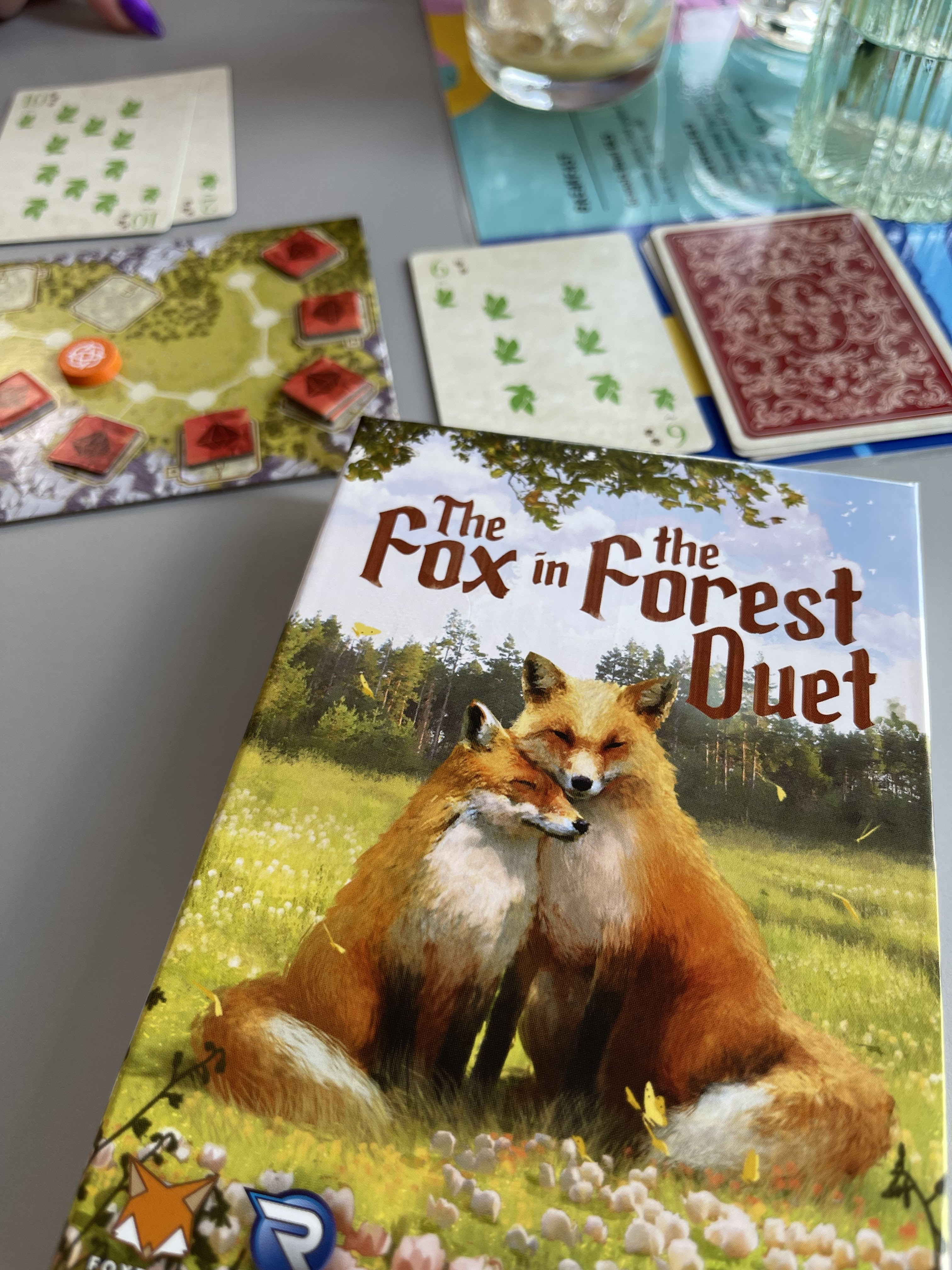
The Fox In The Forest: Duet by Foxtrot Games is a cooperative trick taking card game that sees players immersed in a fairy tale world, finding their way through a fantasy forest, and collecting gems along the way. 

Fans of the original The Fox In The Forest will recognise the core gameplay of playing cards to win, or lose, a trick. However, in this cooperative version the winner of the trick will advance a token along a forest board in one of two directions, and collecting any available gems on the adjacent location. Players have three rounds to try and collect all the gems without the forest path shrinking beyond four spaces, which happens should players ever stray too far in any one direction and at the end of each round. 

For those unfamiliar with trick taking games, players take it in turns to play cards, the highest value in the lead suit played wins the "trick". Player one will play any card, which indicates the lead suit and the value to beat, while player two must play a card from that lead suit if they have one, or another suit if they don't. The lead suit always trumps another suit played unless that other suit matches a "decree" card that is visible to all players. As in The Fox In The Forest, some cards also grant additional actions such as choosing the direction of travel on the forest board, or choosing to ignore a certain amount of movement allowance.

The Fox In The Forest: Duet creates a satisfying and challenging cooperative experience. Players cannot discuss tactics or what cards they have, so the challenge comes from the ability to work wordlessly with your partner to traverse the forest, choosing when to win and when to lose, to ensure that you never stray too far from the path. The gameplay feels smooth and while there is a satisfying amount of tension involved, it creates a calming atmosphere thanks to the lovely illustrations and theme. 

A big problem that I often have when it comes to more abstract games is the question of "why". In more thematic games this is less of a problem, there's usually some story line that sets up the intentions of the characters that the players control, but in The Fox In The Forest: Duet the purpose of the game feels clear.

For a price tag of around £15, the game is well worth the expense and offers plenty of replayability. When we first got it out of the box we played two games back to back (one win, one lose) and it left me wanting more. The addition of the forest path board and movement counter was a nice touch and helps the game stand out from the basic The Fox In The Forest.

Sunday, June 15, 2025

Hand Limit Print Edition Is Coming!

Following the success of our first Hand Limit event during Canterbury Pride, we have decided to increase our in person presence by branching out into print media through the creation of a zine. The talent pool of the Hand Limit Collective apparently knows no bounds.

The launch of the zine, which will be available at a few select outlets for free in the Canterbury city area, will coincide with the launch of our Patreon. We will never hide anything behind a paywall but we are getting to a point now in the growth of Hand Limit as an organisation where we are starting to incur costs related to events and printing, so we thought we would give people the chance to be able to help out if and when they can. This will enable us to continually develop our offer to best meet the needs of the community we serve.

We are very excited about the zine, which is being designed as graphic-heavy, text-light to represent the DIY/punk ethos. Our first issue will be out in Summer 2025 and future issues will be released when they are ready and when we have something that we want to write about. 

If you can't wait and want to support us, you can find our Patreon here.

Friday, June 13, 2025

5 Games That Take Up A Surprising Amount of Table Space

I know you can never judge a game by its box, but usually you can judge the scale of the game from the size of the box. Place a hefty Twilight Imperium or Gloomhaven down on a table and players will instantly brace themselves for a meaty game with lots of pieces, boards, tables, and figures. However, today we're looking at 5 games that come in deceptively small boxes but take up as much space on the table as a big box game.

Tiny Epic Dungeons - Gamelyn Games

We seem to always end up writing about the Tiny Epic series, but that's just because of how many boxes they seem to tick. In this case, Tiny Epic Dungeons ticks the box of being a table-filler. Arriving in a deceptively small box, you would be wise not to underestimate quite how much space this randomly generated dungeon crawl is.

In TE Dungeons, players race to find and battle a number of evil minions in the form of minotaurs, ogres, giant spiders, and more, to unlock the door to the boss' lair before their torchlight runs out and they are plunged into darkness. As Dungeon Crawls go the game is a perfect example of how the genre can be streamlined to just the basics and remain an engaging experience. The combat is satisfying, the loot rewarding, and the enemies deadly. The base game comes with a large number of different enemies to face and characters to play as, each with their own abilities, strengths, and weaknesses. We've had a copy for a few years now and it is one of the more regularly played titles, but no two games have ever felt alike.

This is a table filler of a game, and as the dungeon expands it's likely you'll wish you sat at a bigger table.

Tranquility - James Emmerson

Tranquility by James Emmerson comes in a delightfully small box, with some truly gorgeous artwork, but, you guessed it, takes up a surprising amount of table space. The cards, each sharing a similar footprint to the box, are arranged into a 6x6 grid pattern over the course of the game. This space is marked out at the start with a border of artwork cards, essentially extending the table space required to 7x7 of the box size, which I think beats Gloomhaven, or any of the 'havens, in box-to-table ratio (no I haven't measured this exactly).

Tranquility deserves this level of table space, however, as it is a beautiful and mindful experience. Albiet a very tricky one to get right. Players take turns laying cards down to fill the aforementioned grid with island pictures as you guide a sailor peacefully back home. The catch is that all cards must be placed in ascending order, providing a bit of intuition and guess work to keep things interesting. The game guide also recommends playing the game in silence, or next to silence, to enhance the peaceful tones of the game.

Bandido

O

Bandido is another tile placement game and it really feels like the theme for games that take up an unexpected amount of space require some form of tile placement. In this game, players cooperate to thwart the escape attempts of the titular Bandido as he tunnels his way out of prison. Players will place cards in turn, with limited communication, to guide the tunnels to dead ends, eventually closing off all open ends.

Because the tunnels are randomly generated, there is absolutely no way of knowing at the start of the game which direction it's likely to sprawl off in. Meaning that no matter where you place the starting tile, by about halfway through you'll be desperately trying to reconfigure the table to accommodate the chaotic tunnels.

The pocket-sized nature of this game could easily lull you into the false idea that it would be perfect for a quick game in a cafe. And while that is certainly possible, be prepared to panic when the drinks arrive and they have to be strategically placed around the table!

Lord of the Rings: Duel For Middle Earth

While the other games so far on this list have almost pocket-sized boxes, LOTR Duel is a little bigger from the start. However, we still feel like this game is surprising in the amount of space it takes up, and with good reason.

In LOTR Duel, 2 players take on the roles of the forces of Mordor and the free peoples of Middle Earth in a race for supremacy. Much like its older cousin 7 Wonders Duel, there are multiple ways to win this race. You can focus on uniting the various races, progressing the quest of the ring (or the Ring Wraiths if you are Mordor), or simple military might. It is a terrific game that has done amazingly in condensing the 3 different win conditions into a single game, where each one could have existed in its own right. 

The board itself is only about as large as the game box but the real table hog comes from the card drafting. Cards are laid out in each of the 3 chapters of the game in a configuration that restricts what cards can be drafted at any one time. In a layout that resembles a tarot reading, cards are laid over each other to form shapes that slowly diminish as cards are revealed and drafted.

LOTR Duel is a brilliant game that had us hooked from the beginning, but you'll definitely need more space than the box suggests.

Any TTRPG

Not all Table Top Role Playing Games are created equal. Some are like Lasers & Feelings, requiring little more than a notebook, a pen, some dice, snacks, drinks, fidget toys for those that need them, GM notes, maybe a GM screen. Others, like Dungeons & Dragons, require all that plus the many source books required for playing each scenario, battle maps, miniatures, etc.

Our years playing TTRPGs have taught us one thing, there is never quite enough room for everything that's needed. Players and their bits and bobs, like water, always seem to expand to fill the space they have. Why do you think character sheets always get stuff spilled on them?

Wednesday, June 11, 2025

Hand Limit 2025 Event: Canterbury Pride Board Game Club


On Saturday we held our first ever Hand Limit Event, Pride Board Game Club, and it was a huge success. We seated approximately 58 people playing games throughout the day, plus a further 22 who came in to browse our stalls. We had a lot of fun demoing games, making recommendations, and helping people get set up. The games played ranged from Molly House, to Fluxx, to Ghost Castle. It was particularly nice to meet some fans of the blog as well!

Now that the dust has settled and we've had a chance to take stock of everything that happened, we thought it would be good to share a few thoughts and highlights of the day.


Drawn and Quartered tattoo studio ran a stall selling art prints and temporary tattoos, which were very popular. It was great to see so many people from the alternative community come out and be board game nerds for the day.

Dice & Destiny, our Friendly Local Gaming Store (FLGS) came along to sell and demo some board games including Yogi and Bad Trevor, which were both received really well and were both prizes to be won at the charity tombola.

Kitsch Flamingo ran our tombola, which was hugely popular and had some truly awesome prizes, including tickets to an immersive Grease experience in London, a free aerial fitness course from Inspire Fitness, and a tattoo voucher for Drawn and Quartered, which were all claimed before the end of the day.

Fruitworks Coworking and Coffee Shop, the spiritual home of Hand Limit, was the perfect environment for the day. Their event space was the perfect size and many people enjoyed the fantastic coffee and cakes they offer.

Huge thanks are due to all of our sponsors and contributors. Needless to say we would not have been able to get this far without their support and they helped make the day truly unique.

Throwing this event was a learning curve for us and we have certainly come out the other side with some valuable lessons on what we can change to throw future events and offer the best possible experience to our guests. 
We asked all those attending to fill out a questionnaire giving us feedback and valuable data that will help us run future events. Some highlights of the data we have received so far indicate that 50% of the people attending heard about the event through word-of-mouth, 100% of replies stated that they would like to see more events like this one, 100% said that we had created a safe and inclusive space, and 85% of people said that their mood improved as a result of Pride Board Game Club (the other 15% indicated that their mood hadn't improved, but it hadn't worsened, which is a win as far as we're concerned!). This last point is particularly important to us, as Hand Limit is all about the promotion of tabletop gaming as an aid to positive mental health and community building. Also interesting is the largest group of people (35%) stated that Pride Board Game Club was the first time they had played table top games in a very long time. We will be going through all of the responses carefully and apply any learning to our future activities to make sure we continue to provide a service that is beneficial to the communities we hope to serve.
So where do we go from here? After such a successful first event, Hand Limit is certain to host more in the near future. We are already looking ahead to Pride next year and are starting talks with local community centres to arrange for smaller gaming events targeting specific communities. We want to use this momentum to grow and strengthen the Hand Limit brand and continue to help people by using board games to promote positive mental health and community building.

Finally, I would like to say a massive thank you to everyone who came along on the day. It was all our lovely guests that made this event what it was.

Do you have an event or community group and would like to collaborate with Hand Limit? Please contact us using the Contact Us form on the website.

Featured Article

Games on Location: Episode 3 - The Bloody Inn

Episode 3 of Games on Location is taking a morbid turn with Nicolas Robert's The Bloody Inn, published by Pearl Games. With Spooky Seaso...

Most Popular Post